In Albania archaeologists have found traces of human life from 50.000 years ago. Much later, 6.000 years ago tribes called Illyrians lived in this area, it was one of the oldest civilizations in Europe. To me the name Illyria brings associations to “Lothlorien”, and beautiful people slowly strolling around dressed in white robes… Illyria was an independent kingdom until the Romans conquered it in 168 BC.
There are plenty of remnants from the Roman era in Albania, they were busy here and clever builders. They founded or developed cities in many places, among them Apollonia, where the adopted son of Julius Cesar studied, and Butrint, where Roman soldiers could get land and house.
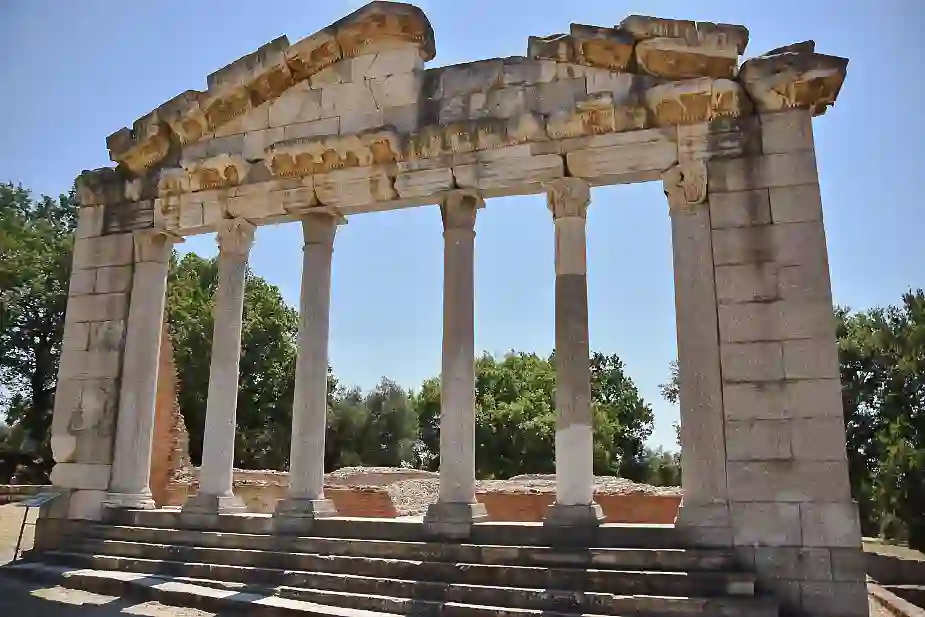
Apollonia lies on a wide grassy hill in the flatlands in central Albania. But two thousand years ago it lay by the sea and was an important port. It was big, an estimation says that 50.000 inhabitants lived here. But sinking sea levels and an earthquake destroyed the port in the 14th century and the city was abandoned. Visiting you can explore the ruins that are only partly excavated, and walk among the galleries, temples, assembly halls and the odeon, a type of indoor theater.
Butrint, another big ruin city lies in the south, between the town of Ksamil and the Greek border. It has remnants from many different cultures, from the Illyrians and onward. A great city wall surrounds it and there’s also an amphitheater, an early christian roman basilica and a forum, among many other things. Perhaps the most startling object is the baptistery, a round construction where converts to christianity were baptized. The floor has fantastic mosaics, but is covered to preserve the colours. By the river there’s a merchant’s house and a grand roman villa.
Butrint is also largely un-excavated and just as in Apollonia you may freely walk around among the ruins.
Butrint’s strategical position made it a target for many attacks and it was frequently conquered. Venetians, French and Ottomans held the city in various periods. But rising water levels in the surrounding river caused floodings and the city was because of this abandoned.
When the Roman empire imploded Albania was raided by slavic tribes. In the 9th century it was conquered by Bulgarians and later it came under Serbian rule. The Serbs were replaced by the expansionist Ottomans, and they held Albania for almost five hundred years. But resistance was fierce in some parts, particularly in the north where the national hero Skanderbeg for a while successfully fought the Ottoman armies. Today Skanderbeg is still respected and you can see a statue of him by the Skanderbeg square in Tirana.
In 1497 almost all of Albania was under Ottoman rule, only some costal areas were held by the Venetians. Almost a third of the population fled to Italy, of those who stayed the majority converted to Islam.
1912 saw Albania at last as a free country, but that almost became a historical parenthesis, as the victorious countrys after the first world war wanted to split it and distribute the parts to its neighbours. An Albanian delegation to the peace conference in Paris in 1920 however managed to stop those plans and restore the Albanian country, which then became a kingdom. As such it continued until fascist Italy invaded in 1939.
We’re almost at the end of our Albanian journey and in the finale we end up on the popular Albanian riviera, a many miles long stretch of beaches where tourists gather and where giant hotels spring up at an extraordinary speed.