Edit Template
Edit Template

Who are we?

This travel blog is created by me, Lars Aldman, a Swedish journalist and traveller, always in the company of my wonderful wife V. who is also a journalist and a fantastic photographer.

I worked for many years for the Swedish National Radio and Television, as a reporter/producer/studio host and a bunch of other roles.but now I’m retired and do whatever I like.

We love to visit foreign countries and cultures and meet people all over the globe. So far we have been to Asia, Africa, South America and the Caribbean and of course Europe. And we’d like to share with You, dear reader, what we have experienced and seen. We hope You want to join us and possibly find ideas for Your own adventures.

PS. To see more of my photos from journeys far and near, head over to aldmangallery.com 

To contact us via mail: info@resormedv.se


Edit Template

More results…

Generic selectors
Exact matches only
Search in title
Search in content
Post Type Selectors
Search in pages

Travels with V

Liège

Travels with V

Liège

A city where you change trains

Liège

We’re really on our way to Luxembourg but strangely there are no direct trains between the EU headquarter cities Brussels and Luxembourg. You have to change trains midway, in Liège. And since we had to, we took some time to explore this historical Wallonian capital, since medieval times a center for coal mining and steel-making. Quite a few of the area’s craftsmen moved to Sweden in the 17th century to help build a metal industry there.

As you leave train station you notice its spectacular roof covering the platforms. It is designed by the Spanish architect  Santiago Calatrava, in Sweden known as the designer of the high-rise Turning Torso building in Malmö.

First impression of Liège is that it’s a bit of a worn down city. We see quite a lot of drunk and obviously poor immigrants roaming the streets. One of them, a man most likely affected by illegal substances starts to stalk us, but we elude him by a classic method – we walk into a shop. Liège is an elongated city and the central parts lie a bit north along the river, a twenty minute walk from the station.

So we walk along the river Meuse, quite broad and with a big marina. The river has played a catastrophic role in the city’s history – several times it has overflown causing great damage to houses and drowning people. One building that was flooded many times is the cathedral St Paul. A massive gothic church with its oldest parts from the 10th century. Inside there are some beautiful statues, among them a rare motif – the defeated and chained fallen angel, Lucifer.

In Liège’s old town there are some noteworthy buildings, among them the Opera house with its modern extension, and the palace of the prince-bishops. French-speaking Wallonia had for several hundred years catholic church leaders that were also princes.

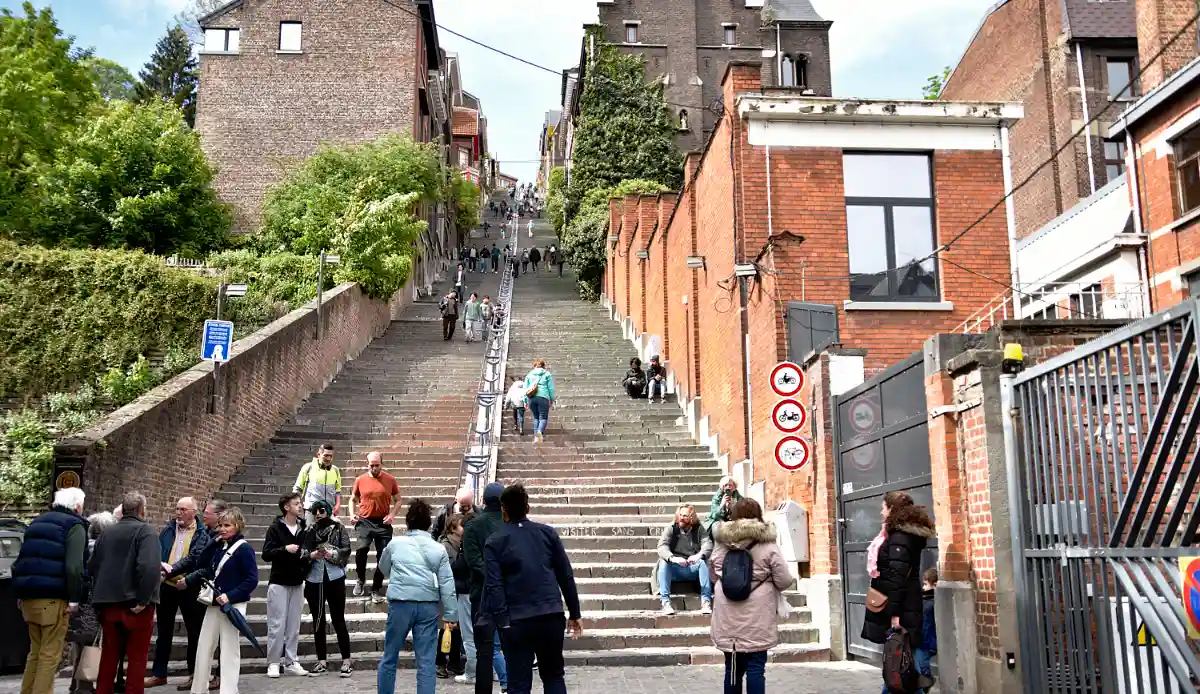
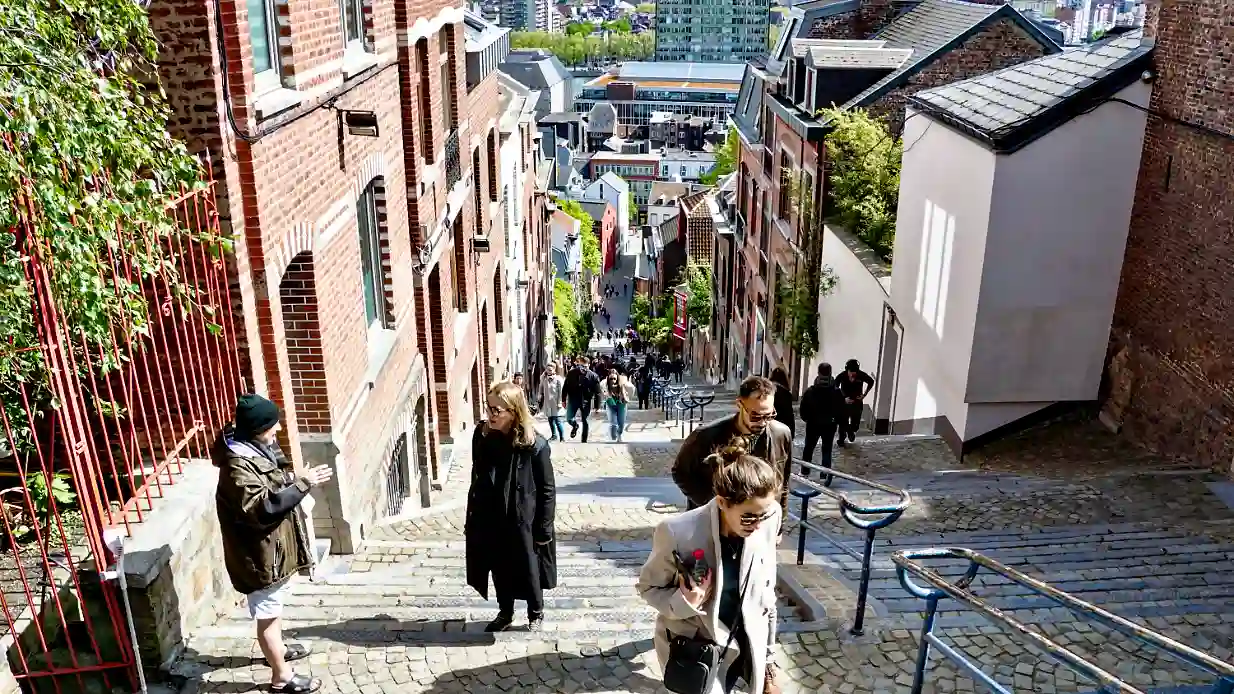
But the main tourist attraction in Liège is, bizarre as it may sound, a staircase. A long staircase with 374 steps. It’s called Montagne de Bueren and it was built in the 19th century to honour soldiers who defended the city against an attack by the Duke of Burgundy, Charles the Bold in the 15th century. We ascend of course and it’s not as hard as it may seem. From the top there’s a great view of the city. 

Our hotel is right by the railway station so we can easily hop on a morning train the next day. It’s an Ibis hotel, but an attempt to create a kind of designer place. And it’s great, good breakfast, a nice bar and very quiet rooms. And it’s just a short walk to the fine dining restaurant “Riva” where we end the day with a superb bouillabaisse and a nice evening by the river. Tomorrow it’s a new town in a new country, Luxembourg.