There are plenty of museums in Havana but we prefer to stay outdoors in the sunshine. Though we make an exception for Museo de la Revolución, a grand palace entirely devoted to Fidel Castro and his comrades and their historical struggle against the dictator Batista’s corrupt regime in 1959. There are bullet holes in the walls and on display is an almost surrealistic collection of bloodied shirts, documents in Spanish (no translation) propaganda, press clippings and dioramas depicting the heroes. Fidel of course, but also Che Guevara and Camilo Cienfuegos (to the left).
Cienfuegos? Yes, absolutely as important as Che. Today his name is unknown to most of us, I myself had never heard of him. But he was very close to Fidel in the Revolutionary army, a loyal and dedicated fighter. He was regarded as being less dogmatic compared to Fidel, a kind-hearted man with humour and lust for life.
In 1959 he disappeared during a flight in a small plane from Santiago to Havana. Still today what happened to him is a mystery, neither his body nor the aircraft was ever found. In the political word fight some say there was a disagreement and Fidel got rid of him. Others blame Cuba’s new enemy, the US.
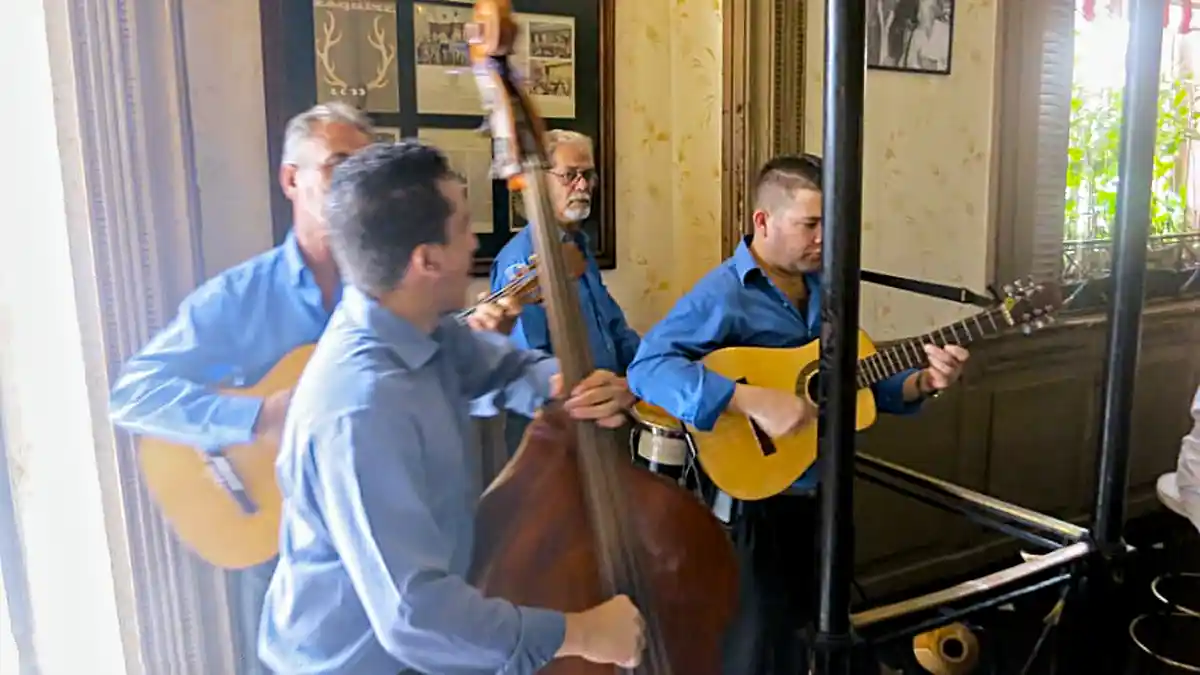
Later we stroll down the Rambla of Havana, Paseo de Martí, leading from Parque Central north to the marine drive Malecón. Though we walk in the opposite direction and sneak into the bar La Floridita, one of Ernest Hemingway’s favourite places when he lived here from 1939 to 1960. And in a way he’s still here, as a statue leaning over the bar counter at La Floridita. It’s a bustling and noisy place with a live salsa band.
The next day we walk a few blocks west to a cross street to the Malecón, called Lealtad. And here lies the paladar Casa Miglis, owned by Michel Miglis, a Swedish guy from Stockholm. He’s actually half Greek too, but the restaurant has lots of Swedish gadgets on display. A picture of the king and queen, red clogs in a frame, and you can get a toast “Skagen” or a tenderloin “Oscar” here. And it’s a success, Casa Miglis gets rave reviews all over.
Michel Miglis, when he was living in Sweden, worked with filmmaking and music, and he still does. He made a price-winning documentary about his own promotion of a Cuban singer, called “El Medico – the Cubaton story”. It’s a surprisingly honest film that doesn’t at all times portray Miglis himself as a perfect guy.
You can read about the movie on its official homepage here.
After the interviw we put Michel in front of one of his six old yankee cars. ”When I came here the first time I felt at home for real”, he says and smiles. He’s really in love with Cuba. Deeply in love.
* But today, March 30, we recieve the sad news that Casa Miglis is closing. The almost total blockade that the US under Trump has laid on Cuba strangled the business.
Cuban foodstores are often a kind of show-off front but with little to offer. The shelves are full but a closer look reveals that it’s a lot of exactly the same stuff. And it’s all canned, boxed or bagged. If you want fresh vegetables, fish or meat you have to find a market, often located on back streets, small courtyards or close to vegetable farms.
We accidentally find one street market close to our hotel, and it really looks great with lots of pineapple, bananas, mango, salad and cabbage, corn, sweet potato and various beans. There’s even a man selling meat. This is where you find the ingredients for your dinner, and the narrow place is swarming with people. And since you pay with Cuba pesos everything is cheap.
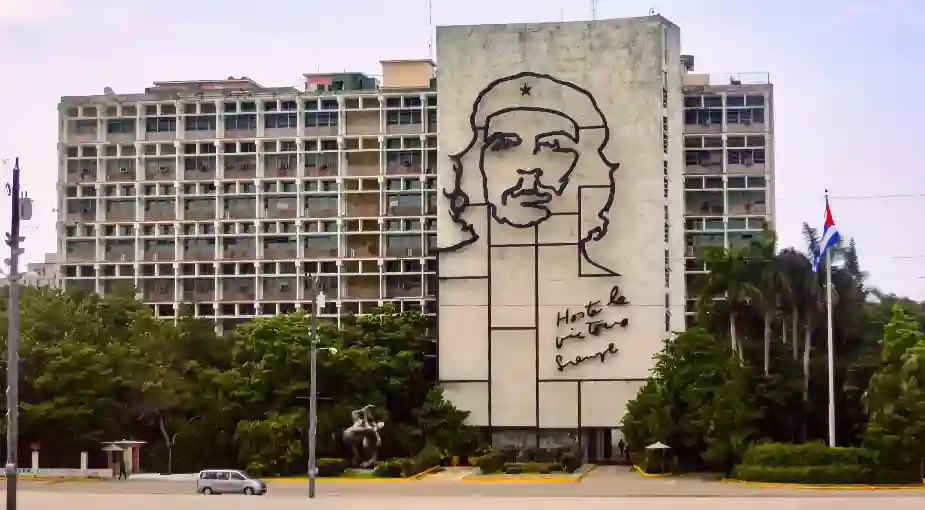
Sometimes when we’re in a new city and want to get a quick overview, we go with the hop on-hop off bus. In Havana it takes us all the way of the Malecón, to the monumental hotel Nacional that has seen many dramatic events before the revolution, among them an outright civil war. We pass the university and end up in the gigantic Revoluton square with its 109 meters tall monument. And the iconic façade of the Ministry of Interior with its giant Che portrait.
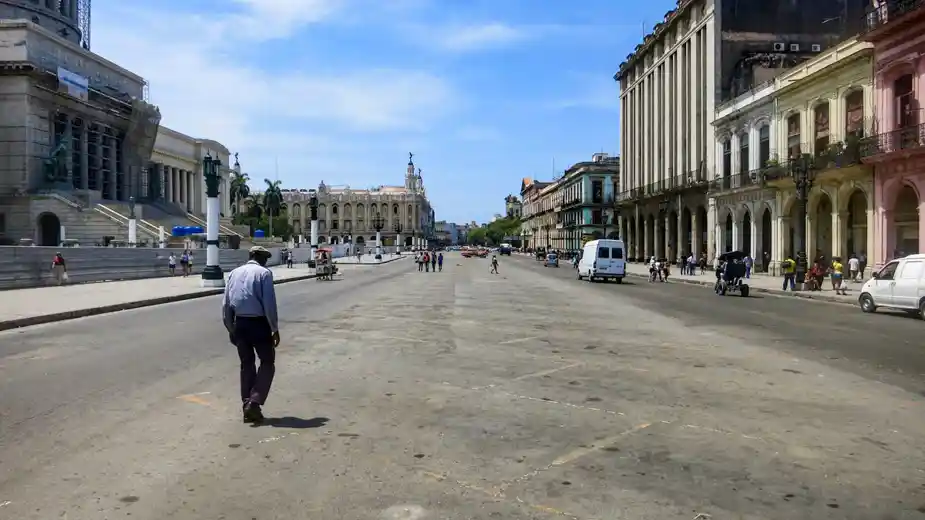
El Capitolio is the palace that was the seat of the Cuban parlament before the revolution. It has been in a state of repair since many years and in time will be be the seat of the National Assembly. An interesting detail: It’s an almost exact replica of the Washington Capitoleum, but it’s one more meter in all dimensions. The Cubans love that kind of comparisons.
There’s so much to see in Havana, You just can’t cover it all in just a few days. We’ll have to come back some day. But for now we leave Havana to hover over the jungle, smoke homemade cigars and paddle along an underground river.